Showing posts with label off grid. Show all posts

Tuesday, June 30, 2009

Yurt Plans, Part 3: Water and Sanitation

The next question to consider once I decided on shelter and power was twofold: Where do I get water for bathing, cooking, and drinking and what do I do with it when I'm done? The first portion of that is relatively simple. I can get a used food-grade 50 gallon barrel for relatively cheap, so that will be my storage. But then what to do with wash water when I'm done?

That leads to another, more difficult question. What do I do with my, erm, gastric byproducts?

{disclaimer: from this point forward I will be discussing the composting of human excrement, that is to say, poop. There may be attempts at low-brow scatological humor. If this subject makes you uncomfortable, it's okay. I'm not extremely comfortable with it myself. Fecophobia is very common in western culture. Let's step right in, shall we?}

My first thought was, ewww, I really don't want to be up to my elbows in... hard work trying to dispose of my wastes. I was hoping to find some magic solution to just make it go away; but as my old boss used to say, you can wish in one hand and... Oh, never mind. What I ended up learning was that there are only a few ways to have an off grid toilet.

The first one most of us are familiar with- the latrine. Just a hole in the ground that you do your business in. Smelly, cold in the winter, hot in the summer, and, as it turns out, horrible for the environment. Latrines don't actually treat the waste, they just wait for anaerobic decomposition to take place. In the meantime, pathogens are leaching into the surrounding soil and can travel up to 50 feet laterally. In addition, when it fills up, a new one needs to be dug or the old one scooped out. No thanks.

Another method is incineration. There are commercial toilets that use an electric element to incinerate your deposits. Periodically you remove a sort of dust from a tray below the toilet and discard that. This method works well, but requires an obscene amount of energy and can stink.

The third method is composting. I started looking at commercial composting toilets, and found that, while efficient and odorless, they cost around $2000 each. That's more than twice my yurt budget! I was starting to think I was up a creek and out of luck, but then I found The Humanure Handbook by Joseph Jenkins.


This self-published 250-page volume outlines a composting toilet system in which the actual composting takes place in an outdoor compost pile, and the toilet is simply a receptacle that gets emptied periodically. But that's not the interesting part of the book. Jenkins makes a carefully researched, well-supported case for large scale 'humanure' composting. He points out that all creatures in nature form a nutrient cycle with their environment and nothing leaves the system. He then contrasts that with our current nutrient cycle:


Interesting point, but what about smell and disease? Jenkins says that, done properly, this system has no odor and the composting temperature will kill all harmful pathogens to the point that the compost can be used to grow food. Cool.

Jenkins' book is available from Amazon or the publisher's website: www.jenkinspublishing.com. The first edition of the book is available for free on the website.

Tuesday, March 3, 2009

Yurt Plans, Part 2: The Juice

After people get used to the idea of a yurt, one of the first things they ask me is what I intend to do for electrical power. Usually followed by, "You will have electricity, right?" Oh, I shall have electricity. I will have my dual-core gaming computer and I will have my 720p DLP projection system with Dolby 5.1 surround sound. There are some things that I am simply not willing to give up. But how? That, dear reader, is where I have an idea. Wind power, but not in the way that most people think of it.

I considered three power generation methods as I was designing the electrical system: solar, wind, and hydroelectric. There aren't many sources of flowing water around here with enough of a drop to be effective, so hydro was out. Solar power is wonderful, but expensive. Major breakthroughs in solar panel manufacturing are being made by companies like Nanosolar and AVA Solar, but their solutions are years away from the consumer market. That leaves wind power. There's plenty of wind on the Colorado front range, and quality wind turbines can be built on the cheap by the determined DIYer.

I then got to thinking about the de facto power storage medium for off-grid residences: batteries. Batteries are expensive and full of toxic chemicals. They wear out after a few years, and must be repurchased. I decided that I don't like batteries. So I started searching for a better way to store energy.

Back to the basics: energy can be stored in several ways. This can include chemical (batteries), mechanical (reservoir for a hydroelectric dam), or thermal (geothermal plants). Utility companies in Huntorf, Germany and in McIntosh, Alabama have been storing energy mechanically in a process known as Compressed Air Energy Storage (CAES). This is done on a massive scale, with excess grid electricity being used to run gigantic air compressors that pressurize an entire underground cavern. The compressed air is then used to run air-powered generators when demand is at its peak. This process is inherently inefficient, with electricity being converted to mechanical energy then back again with all sorts of heat losses in the process.

[image from Wikipedia]

What if the process of storing energy in compressed air was streamlined? I think a process that uses a windmill that converts mechanical wind energy to electricity that is used to run an air compressor to store compressed air that is then used to make electricity all over again (whew!) is perhaps a bit complex and wasteful.

My system will use a windmill that directly drives an air compressor instead of a generator. The air will be pumped into storage tanks. When electricity is required, the compressed air will run an air motor/generator and supply the needed current.


This will take a considerable investment of time, research, and testing to properly implement, so for the first year I will be using a gas generator (possibly converted to run on cheaper propane) to supply my electrical requirements. If anyone out there manages to beat me to it, let me know how it turns out. Until next time(water system).

Monday, February 16, 2009

Introduction

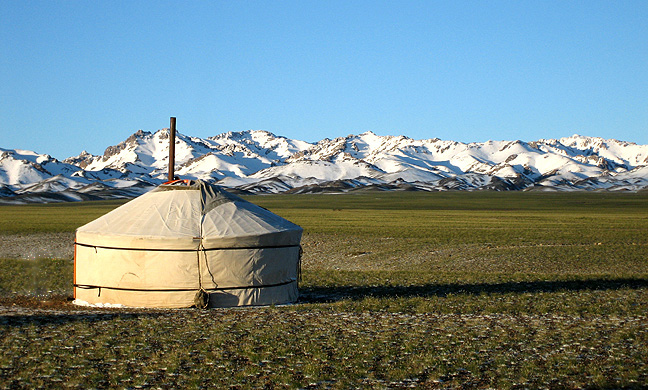
Hello, world! Welcome to my first ever blog post. I've started this blog to chronicle my progress while I build and live in an off-grid yurt. The yurt is a portable dwelling consisting of a circular wooden structure typically covered in felt. Here's a picture of a traditional Mongolian design:


My yurt will be made with more readily available materials(I don't have an entire flock of sheep on hand to make a yurt cover, for example), but I'll get into that later.

I hope, over the course of the next several years, to provide a viable alternative to the traditional Western idea of a home. One that is as comfortable and convenient as tradition dictates, yet places less strain on its surrounding environment, and is much less dependent on fossil fuels.

I believe that we as human beings possess the intelligence and ability to either destroy or preserve the earth we live on. I also believe that, as creatures with a limited life span, we cannot own the earth. Sure, we may stake our claim and hold it close, but the simple fact is that when we're long gone that piece of earth will still be there. We're all just stewards, when it comes down to it. And for my part, I think that it is our solemn responsibility to be good stewards.

Part of that is planning for those who will take over when we're gone. It is irresponsible and an example of bad stewardship to base an entire civilization upon a finite fuel source(fossil fuels). Whether we're running out now, or will in a couple hundred years, it does not matter. The simple fact is that we will run out, and when we do, we need to be prepared as a matter of necessity. I understand that the technology simply does not exist to fully transition today. Or tomorrow. Or in a decade. That's why(in part) I am doing this.

It is possible to live sustainably in today's culture without being wealthy. It is possible to greatly reduce your need on fossil fuels without being a hermit, or crazy. These are the things that I intend to demonstrate over the next few years. I hope that you, dear reader, will follow along and share in my triumphs(and failures) over the next several years.